
Nestled in the heart of East Nashville lies Episcopal School of Nashville (ESN). Known for its inclusive Episcopal identity, urban setting and commitment to nurturing curiosity and character, ESN offers families a unique school experience rooted in academic excellence and emotional intelligence. With Head of School Dr. James Jordan at the helm for nearly five years, ESN has continued to carve out a special place in Nashville’s education scene.
Now in preparations for celebrating 10 years of ESN, northern England native Dr. Jordan sat down with Nashville Parent to share more about the school’s mission, milestone moments, future challenges and the exciting path that lies ahead.
NP: What sets ESN apart from other schools in the area?
JJ: There is no other Episcopal school in Nashville. We are unapologetically Christian, but we are not trying to indoctrinate anybody. We have Catholics, Methodists, Congregationalists and students of no faith tradition. All are welcome under the umbrella of an Episcopal School. We focus on academics, social justice, and inclusion in a place where everybody is welcome.
Our baptismal covenant demands of us to strive for justice and peace among all peoples and to respect the dignity of every human being, period. And this is not something that we made up here in Nashville. It is a tradition that goes back centuries to England. You can come here and you can be yourself. We have all kinds of family structures, socio-economic backgrounds, races, and countries where students are from. The cool thing about ESN is that you don’t have to check any of that at the door.
In terms of our academics, we’re very hands on. We’re very careful about technology. We believe that interaction and hands-on experiential learning is really important, especially for young children. And a screen is not a solution. A screen can be a tool to help you achieve an educational objective, but it’s not the end. It’s a means to an end.
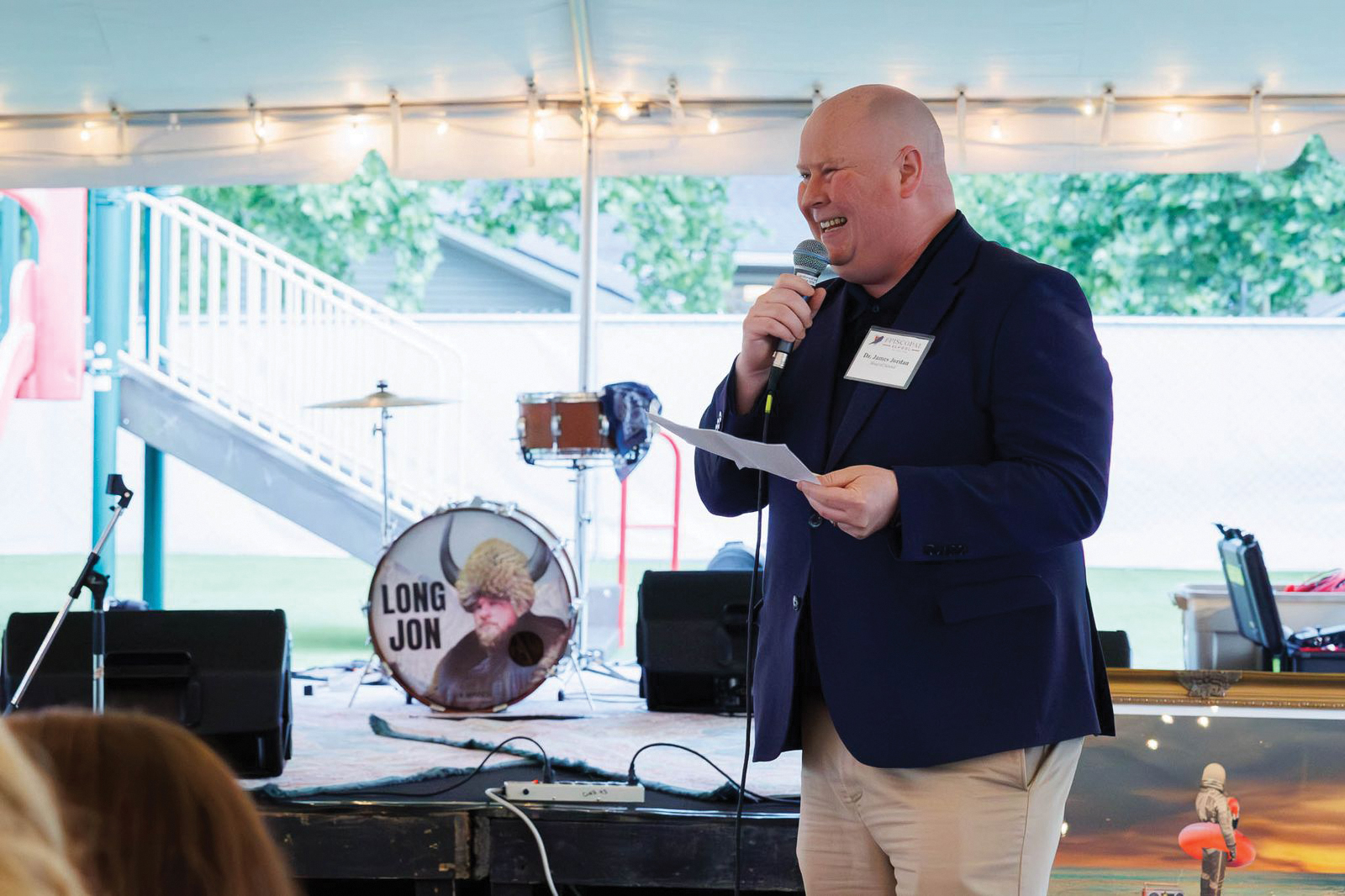
Dr. James Jordan at the Episcopal School of Nashville’s annual Purple Martin Palooza fundraiser.
NP: What is a common misconception that people have of Episcopal schools?
JJ: Faith-based schools get a hard rap. People growing up may have had certain feelings or been made to feel a certain way, like, “Hey, if you don’t believe exactly these things, then you’re less than.” The Episcopal tradition seeks to tear down those barriers. Like I said before, you don’t have to be a Christian to come to this school. You don’t have to be an Episcopalian to come to this school. We believe that diversity is our strength, and diversity can take many forms. We’re socioeconomically diverse, and we put our money where our mouth is, with a lot of need-based financial aid. We want to be racially diverse and diverse with ideas and perspectives. We want our students to be critical thinkers. The Episcopal way is the middle way, so there is truth on all sides.
NP: Looking back on nearly a decade of ESN, what key milestones has the school achieved, and what are your goals for the future?
JJ: We started with 16 students in two trailers in the parking lot of a church in 2016 with literally a wing and a prayer. Today, we are in the Ross Elementary building. Our target is 140 students for this upcoming year, and each year we’ve grown.
Our theme for year 10 is “Purpose, Promise and Possibility.” We started out as that young, scrappy school, and now we’re in the phase of really thinking big. We’re embarking on a strategic planning process that will set the course for the next three-to-five years. What we’ve done really well in the last year or so is creating the shared understanding of, “What does Episcopal actually mean, and how does that tie into what we do?”
We are working to make our academic program as rigorous as possible. This year, we’re implementing a new math program. Next year, we’re going to really dive into language arts. As an independent school, we get to determine our own mission, and how to carry out that mission. We can teach what we want — no book bans here. There’s no, “You must do this. You can’t do that.” We’re a community of choice and values, and we want our curriculum, people, programs and practices to reflect those values. We’re really dedicating ourselves to the mind, body and spirit of every young person, so that when they leave us after sixth grade, they’re prepared to go to any of the great public or private schools in Nashville and thrive, and people will say, “That’s an ESN kid.” That’ll make us proud.
We’re also looking at a permanent facility. I would love to have a soccer field, a gym, a chapel — in the longer term, we’re looking at a campus for ESN.
 NP: Where do you see education going for this next generation of learners; how are you addressing that at ESN?
JJ: I was in an AI workshop recently, and oh my goodness. In the elementary sphere, it’s a little easier for us to really double down on social, emotional, and academic skills and less on technology. Education is relational, right? We serve students as young as 3, and they’re learning to take their turn, play nicely and respect others. As they get a little bit older, they’re learning to use their words instead of their hands or their bodies, which a computer will never replace. We believe in the concept of community, and that will not change.
In terms of the future of the country, we want to educate our students for the world that we want to live in. In 10 plus years, we want people to be able to disagree and still feel that they’re friends. We don’t want to live in a polarized society. It all comes back to relationships and being able to articulate oneself, receive feedback and reflect. To create a space for students to do that in communion with others who value them as a human being, and maybe disagree with the idea that they have about one thing or another, but are a part of this community of humanity. My hope is that we build on that, rather than getting into a more transactional model of education where it’s a factory. Education is personal and it’s interpersonal, and especially for this age group of elementary and early childhood, it needs to be in a loving environment where every single child is known, valued and loved with the opportunity to be themselves.
NP: What excites you most about leading this community?
JJ: It’s the type of school I wish I’d gone to growing up. It’s the type of community that I would want my children to go to, because regardless of who they are or what they’re interested in, they’re going to be valued as a human being. They’re going to have that sense of self. We’re intentional about relationships and community building, and it’s only going to get stronger.
Learn more about Episcopal School of Nashville here.
Subscribe to our weekly Newsletter for parenting tips, top things to do, our #WINSday contest and lots more!

Discover More Parenting Content and Things to Do!