

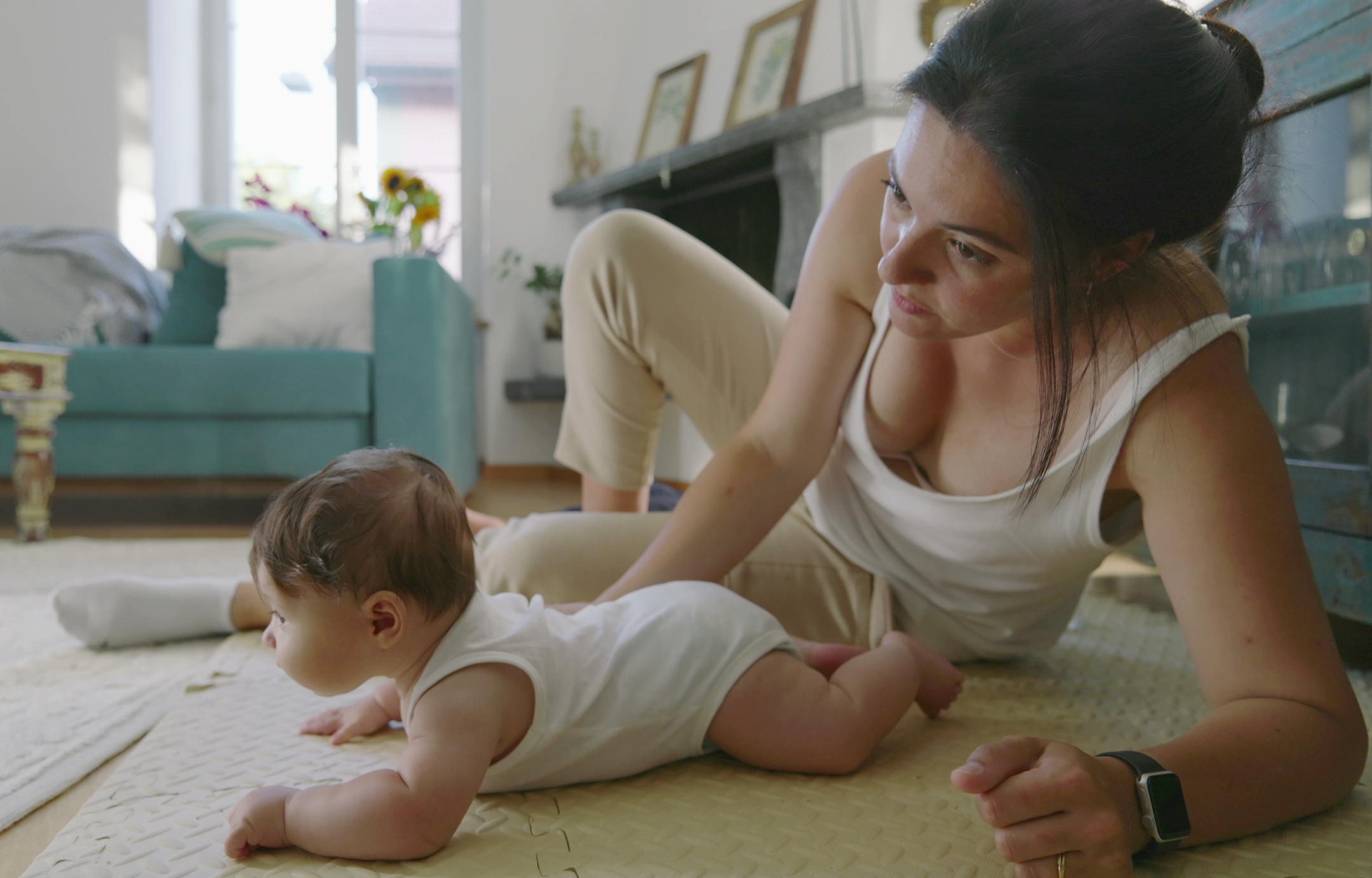
Let’s be honest — we parents love hunting for little clues that our babies are pint-sized geniuses. Is that first babble actually a word? Did your little one just know who Grandma was? While it’s usually just a sweet way to confirm what you already believe — that your baby is absolutely extraordinary — it turns out you might be onto something regarding your baby’s intelligence.
A fascinating new study from the University of Colorado Boulder found that babies really do show early hints of their future brainpower. In fact, researchers discovered it could be possible to predict how well someone will ace a cognitive test in their 30s from what’s happening in their brain at just 7 months old.
So how exactly can your baby’s busy little brain reveal its grown-up potential? Let’s take a closer look.
Turns out, your little one’s early environment — basically everything happening before age 3 — can leave a lasting mark on their brainpower later in life.
Baby’s Intelligence: Decades Worth of Data
To crack the mystery of how baby brains grow into big, brilliant ones, researchers at the University of Colorado Boulder pulled together a seriously impressive team—500 families with twins! (Yes, that’s a lot of matching outfits.)
They followed these twins — both identical (sharing 100 percent of their genes) and fraternal (sharing about 50 percent just like regular siblings) — starting when they were just 7 months old. Then they checked in again at 9 months, age 1, every year all the way to 17, and then every five years into their 30s. Talk about commitment.
By collecting decades’ worth of data, the scientists wanted to see how much of our smarts come down to good old DNA versus the environment we grow up in. Comparing identical and fraternal twins gave them the perfect way to tease apart nature and nurture.
As Daniel Gustavson, Ph.D., the study’s lead author, explains, “shared environment” includes everything from your family’s cozy living room to your neighborhood, your schools, and all the places that shape a child’s early world.
So, what did all this twin-wrangling uncover? Turns out, your little one’s early environment — basically everything happening before age 3 — can leave a lasting mark on their brainpower later in life. In fact, Gustavson says it accounts for about 10 percent of the differences in IQ between people. Not too shabby for the toddler years!
Baby’s Intelligence: Busy Brains
To get a peek inside those busy baby brains, researchers used seven clever tests. There was the “novelty preference” task (do babies get excited about a shiny new toy or stick to the same old one?), listening to all their adorable babbles, watching how they track moving objects, and rating their attentiveness, energy, and mood. They even broke out the Bayley Scales of Infant and Toddler Development — basically the gold standard for tiny tot milestones.
While these baby tests at 7 to 9 months could only predict a small slice of adult IQ, things got a lot more telling by age 3. From then on, yearly check-ins could predict about 20 percent of those differences in smarts. And by ages 7 through 16, genetics really start calling the shots, with IQ prediction ramping up fast.
And don’t forget — IQ is definitely not the whole story. Just because your kid might be a little brainiac doesn’t automatically mean they’ll grow up to be a wonderful human (or even a decent roommate).
There are personality traits — like kindness, empathy, being genuine, and actually listening to people — that don’t show up on any intelligence test but are, in many ways, way more important than how high you can score on a quiz.
So celebrate those smarts and all the beautiful qualities that make your child uniquely awesome.