


As a mom in my forties now, I’ve walked through puberty once already — hand in hand with my daughter. I won’t sugarcoat it: it was one of the most emotionally intense, confusing and, at times, heartbreaking season of our lives. Not because anything was “wrong,” but because everything was changing all at once — for her and for me as her parent, just trying to keep up.
The Rollercoaster Begins
When my daughter first entered puberty (she was 12), it felt like someone had quietly swapped out my child for a stranger who looked the same but felt everything more deeply, more urgently. Suddenly there were big emotions where there used to be simple ones. Now there were insecurities, longings to belong, fears of rejection. She didn’t always have the language for what she was feeling, and I know I struggled with knowing the helpful things to say.
PODCASTS CAN HELP
ASK LISA: The Psychology of Raising Tweens and Teens
Highly regarded, popular podcast with science-backed, practical advice from bestselling author and psychologist Lisa Damour and journalist Reena Ninan.GOOD INSIDE PODCAST: THE IN-BETWEEN YEARS
Clinical psychologist Dr. Sheryl explores what’s really happening to kids during this stage of life.CALM PARENTING
Hosted by Kirk Martin of Celebrate Calm, this podcast focuses on stopping yelling, power struggles and more.
An Emotional Avalanche
What I learned quickly is that puberty isn’t just physical — it’s a mental and emotional hurricane. Young teens are trying to make sense of their changing bodies, their emerging sexuality and their place in a social world that suddenly feels higher-stakes. And many of them are doing it quietly, because they’re embarrassed, afraid or convinced no one will understand.
I saw that play out with my girl in two very different ways. Some days, my daughter puffed herself up — confident, dismissive, acting like she had everything figured out. Other days, she retreated completely, shutting her door, overwhelmed and unsure of herself. At first, I made the easy mistake: I responded to what I saw on the surface. I tried to “correct” the attitude or “fix” the withdrawal.
But what she actually needed was for me to see underneath it.
That bravado? It was armor. That silence? It was fear.
One of the most important shifts I made as a parent was moving from managing her behavior to understanding what she was experiencing. Instead of pushing her to socialize when she was overwhelmed, I started asking gentler questions. Instead of praising her confidence at face value, I checked in about what she was feeling underneath it. I learned to sit beside her discomfort instead of trying to immediately solve it. It was hard for me!
 It’s Supposed to Be Wild
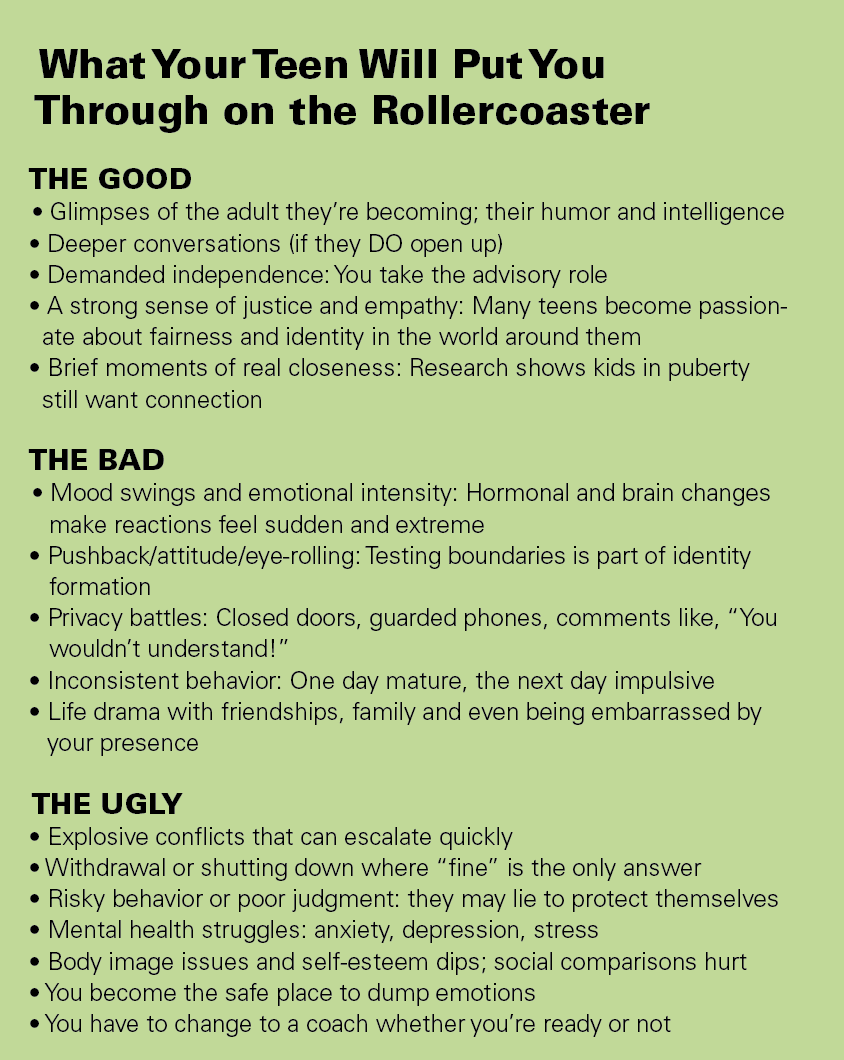
Experts like Lisa Damour, author of Untangled: Guiding Teenage Girls Through the Seven Transitions into Adulthood, emphasize that adolescence is supposed to be turbulent. She explains that emotional volatility, risk-taking and withdrawal are signs of development. She says our job as parents is to help our kids tolerate it and move through it safely.
“Knowing that you can serve as a reliable, safe base allows your teenager to venture out into the world,” Damour. “Our job is not to make things perfect, but to help them develop the skills they need to handle whatever comes their way,” she adds.
That perspective changed everything for me. It helped me stop seeing her struggles as personality problems I needed to address. And to start seeing them as experiences to support.
And here’s the part I wish more parents understood: the mental load of puberty can drive kids to make decisions they’re not ready for. Not because they’re reckless, but because they’re overwhelmed. A child who feels insecure might act overly confident and rush into relationships or physical intimacy before they’re emotionally equipped. Another child, afraid of rejection, might isolate themselves so completely that they lose opportunities to connect and grow.
Neither of those kids needs pressure. They need attunement.
Wired for It
I also found guidance in the work of Daniel J. Siegel, who writes in Brainstorm: The Power and Purpose of the Teenage Brain that teenagers in puberty are wired for emotional intensity and social connection. Siegel says parents may have to leave their comfort zone to stay connected rather than clamping down. To listen more than lecture and to remain a steady presence even when the child pushes you away.
That was really hard. There were moments I wanted to react, to tighten control, to demand clarity or compliance. But what helped my daughter most was knowing I was still there — calm, available and not judging her for what she was feeling.
If I could tell other parents anything, it would be this: don’t take puberty at face value. The loud confidence might be hiding deep insecurity. The quiet withdrawal might be a child desperate to be understood. And the “bad decisions” we fear are often just attempts to cope with feelings that are too big and too new.
Our kids don’t need us to make this phase smooth — they need us to make it safe. And when we do that — when we offer patience, curiosity and steady support — we give them something far more lasting than protection. We help them build a sense of self that can carry them through not just puberty, but the rest of their lives.