

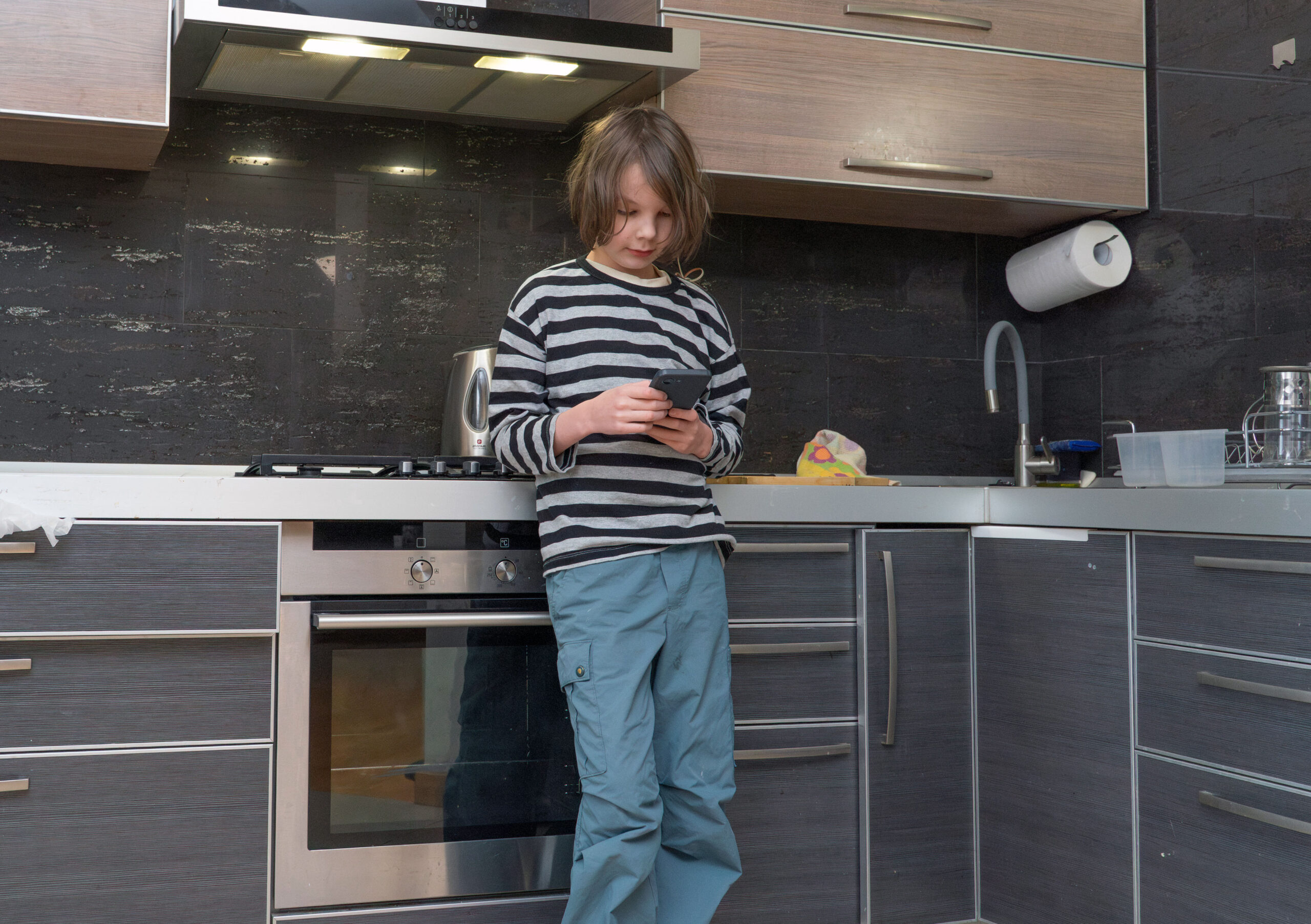
The first time I realized my child had become a big kid, it wasn’t because of a birthday or a new school or any of the milestones we tend to photograph and announce. It was something much smaller. I was in the kitchen, and my 12-year-old boy was sitting nearby with a phone, laughing at something on the screen. I asked what was funny. “Nothing,” he said, without looking up.
Of course it wasn’t nothing. There was a person on the other end of that phone, a conversation I wasn’t part of, a joke I hadn’t heard. And that was the strange part. My child was sitting 10 feet away from me, but there was suddenly a part of his life that I couldn’t see.
This is one of the less advertised transitions in parenting. Your child doesn’t become independent all at once. It happens in tiny increments: a bedroom door that starts staying closed, a friend whose name you hear more often than you see, an opinion that seems to have arrived fully formed, a password you don’t know. The first smartphone simply makes all of it harder to ignore. It gives a child a social life that can travel home with them, stay awake after they do, and continue without their parents ever knowing that anything is happening.
When we talk about the first smartphone, we tend to talk about it as a technology decision. What age? Which phone? Which apps? How much screen time? Those are reasonable questions, but they weren’t the questions that bothered me most. What bothered me was the realization that the phone represented something larger: my child was beginning to have a life that was not entirely mine to oversee.
That is, of course, what we want. The entire project of raising a child is supposed to end with a person who can function without you. But there is a difference between wanting independence in theory and discovering, one ordinary afternoon in the kitchen, that your child has started practicing it.
The phone isn’t really the problem
The American Academy of Pediatrics has increasingly moved away from the idea that there is one magic number of minutes that determines whether a child’s relationship with technology is healthy. Its current guidance asks parents to look at what children are doing with media, what it is displacing, whether it is interfering with sleep and relationships, and what makes sense for that particular child and family. That seems more useful than the old question of whether an hour or two hours or three hours is acceptable. An hour spent making a video with friends is not necessarily the same experience as an hour spent alone scrolling in bed at midnight. The screen is only the setting. The more interesting question is what kind of life is happening around it.
That question gets complicated quickly, because the life happening around the phone belongs increasingly to the child.
Sooner or later, every parent of a suddenly big kid hears, “But so-and-so is allowed to.” So-and-so has the app. So-and-so can stay up later. So-and-so’s parents don’t check their phone. So-and-so is allowed to go to the party. It is tempting to hear these comparisons as challenges to parental authority, and sometimes they are. But they are also evidence that something important is happening: your child has discovered that your family is not the only way to live.
For a long time, parents are the center of a child’s universe. We explain the rules and decide what is safe. Then friends become important, and other families become reference points. The child begins to notice that one family eats dinner at six and another doesn’t eat together at all; one family has strict rules about phones and another seems to have none. The child starts comparing, evaluating and, occasionally, making a surprisingly persuasive case for why our rules should change.
I don’t want my child to believe that our rules are universal. I want him to be able to encounter another family’s way of doing things and understand that different doesn’t necessarily mean wrong. But that requires a different kind of parenting from the one I did when he was little. It requires explanation, negotiation and sometimes the uncomfortable admission that a rule that made sense two years ago may no longer make sense now.
Privacy is Not the Same Thing as Secrecy
The hardest negotiation, though, may be over privacy. Teenagers have always needed a private world. What is different now is how much of that world exists on devices that parents can technically enter. A parent can read a message, check an account or demand a password. The fact that we can doesn’t necessarily mean we should.
There isn’t a clean line between privacy and safety. If a child is being bullied, threatened or manipulated, a parent may need to intervene. If a teenager is simply having an embarrassing conversation with a friend, invading that conversation may do more harm than good. The job is to know the difference, and sometimes the truth is that we won’t.
Research suggests that this private online world is not trivial to teenagers. Pew has found that 74 percent of teens say social media helps them feel connected to what is happening in their friends’ lives, even as many also describe social media as a source of pressure, drama and exclusion. From an adult perspective, a teenager staring at a phone can look isolated. From the teenager’s perspective, that phone may be where the social world is happening.
This is why I have started to think that the goal can’t be to know everything. It has to be to create a relationship in which a child can tell you something when it matters.
That sounds simple until you consider what happens when the thing they are telling you about is something you don’t understand.
Then the Machine Starts Talking Back
AI has arrived in the middle of this transition, and it may be the strangest part of all. We are accustomed to children knowing things their parents don’t know. What is new is that they can ask a machine. By early 2026, Pew found that 64 percent of American teenagers had used AI chatbots, and more than half had used them for schoolwork. Some were using them for emotional support or advice.
The idea of a teenager asking a chatbot for help is unsettling in part because the chatbot doesn’t just give an answer. It talks back and can be patient and sympathetic and confident. It can also be wrong, and it has no actual knowledge of the child sitting on the other side of the conversation. UNICEF has warned parents about children sharing personal information with AI and about the possibility of becoming overly reliant on AI for answers, reassurance or companionship.
I don’t think the useful parenting lesson is simply “Don’t use AI.” That is unlikely to work, and perhaps it misses the point. The more important lesson may be judgment: How do you know whether an answer is true? What information are you giving away? When should you ask a person instead? What happens if you let a machine do all the thinking for you?
Those are questions I am still learning to answer myself.
That may be the defining feeling of parenting at this particular moment. We aren’t handing our children a world we already understand. We are discovering parts of it alongside them.
What does a Healthy Childhood Look Like Now?
And meanwhile, the definition of a healthy childhood has become its own source of anxiety. Parents can spend an extraordinary amount of time wondering whether children are getting too much technology and not enough of everything else. But perhaps the useful question isn’t whether childhood should be screen-free. It is whether childhood still contains the things children have always needed: sleep, movement, friendship, boredom, family, competence, time outside, time alone and the chance to make mistakes without an audience.
A healthy childhood in 2026 probably isn’t going to look like the childhood many of us remember. It shouldn’t have to. The world has changed. But there should still be room in it for a kid to be bored, to get lost in a book, to ride a bike, to have a fight with a friend and work it out, to fail at something without immediately asking a machine for the answer. The technology can be part of the childhood without becoming the childhood.
We Gave Them a Digital Childhood Before They Could Object
And then there is the irony that may be hardest for parents to face: many of us are asking our children to think carefully about privacy after spending their entire childhoods documenting them.
We posted the baby pictures and the first-day-of-school pictures and the funny stories. We put their childhoods online before they were old enough to understand what online meant. UNICEF has raised concerns about this practice, often called “sharenting,” particularly around children’s privacy and the fact that parents may create a permanent digital record without the child’s consent.
Eventually the child becomes old enough to object. Maybe the photograph is embarrassing. Perhaps the story isn’t ours to tell anymore. Maybe they simply don’t want strangers knowing something about them that we thought was harmless.
That moment feels connected to the phone, and to the password, and to the closed bedroom door. They are all versions of the same thing: a child becoming separate from the parent who has spent years knowing almost everything.
I still want to know who my child is talking to and what he’s watching. I still want to understand the joke that made him laugh in the kitchen. But I am beginning to understand that I don’t need to know everything to remain close.
Maybe that is the strange assignment of parenting a suddenly big kid. The job changes from knowing where they are to helping them learn how to navigate places you cannot always follow. You become less of a gatekeeper and more of a place to return to.
The goal was never to keep them small enough that you could always see them. It was to raise someone who could eventually do things you couldn’t see and still know where home was.