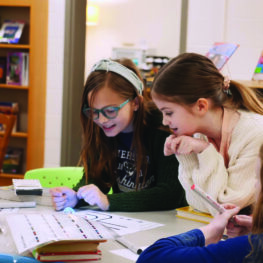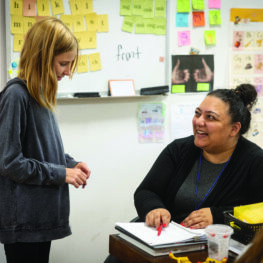

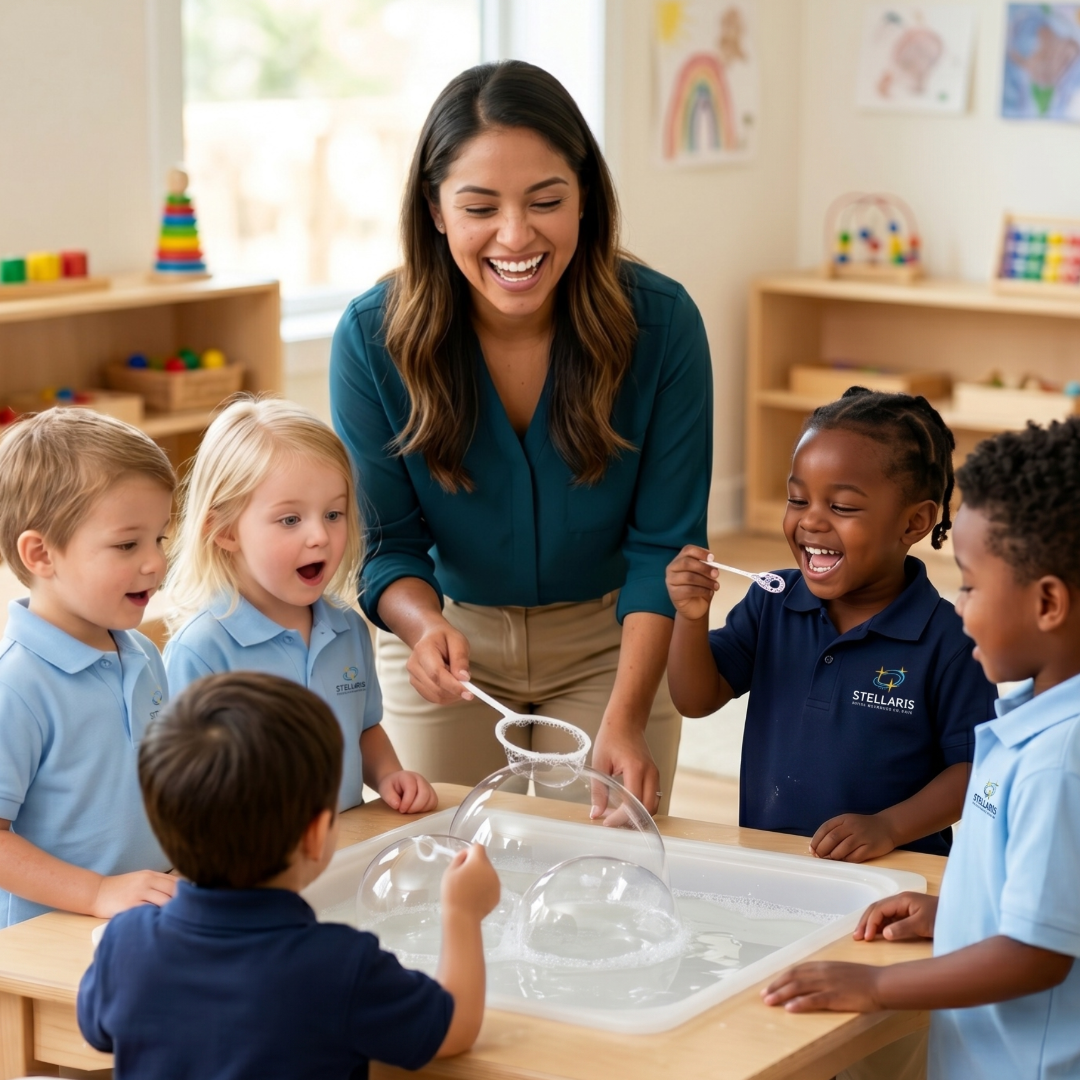
Imagine a classroom where a simple question like “Why do bubbles float?” doesn’t lead to a quick answer, but instead sparks a full scientific investigation. Picture young children gathered around a tray of water and brightly colored straws, testing their own ideas, revising their thinking, and discovering new possibilities. A teacher smiles and and gently, thoughtfully guides the process in Spanish.
For many parents of preschool and kindergarten-aged children, this is exactly the kind of learning moment they hope for: joyful, hands-on, and filled with wonder.
That spirit of exploration is at the heart of what families will find at Stellaris International School, a new bilingual, inquiry-based school opening in Nashville in August 2026. Designed for young learners during the years when curiosity is naturally at its peak, Stellaris creates an environment where learning flows from a child’s own inquisitiveness rather than passive instruction.
While the Hillwood campus is new, the vision behind it is grounded in decades of experience. In 2009, founder Erin Defossé and Head of School Alexandra Castro partnered to launch Magellan International School in Austin, Texas. What began as a small early childhood program has grown into a thriving community of nearly 700 students, becoming the only fully bilingual IB Pre-K through Grade 12 program in the United States. Stellaris builds on that foundation, bringing the same innovative approach to Nashville.
At Stellaris, children’s questions become the engine of the curriculum. Inspired by the International Baccalaureate (IB) Primary Years Programme, the school moves beyond traditional worksheets to cultivate critical thinking and inquiry-based learning. In a world shaped by rapid technological change, memorizing facts is no longer enough; the true advantage lies in learning how to think. By giving children agency in their learning, a lesson about plants might naturally expand into explorations of weather, nutrition, or the environment. This approach helps children grow into adaptable, creative problem-solvers.
Equally important is Stellaris’ immersive bilingual environment. Spanish immersion begins in the early years, when children are naturally primed for language acquisition. Guided by experienced educators recruited from around the world, this model does more than build communication skills; it opens a window into diverse perspectives and fosters empathy from an early age. Bilingualism is also associated with stronger problem-solving skills, an advantage Stellaris nurtures as children learn to shift between languages and ways of thinking.
For parents navigating the significant decision of where their child’s educational journey should begin, this combination of warmth, curiosity, and global awareness can feel especially meaningful. Preschool and kindergarten are not only about learning letters and numbers; they are the years when children begin forming their identity as learners and building the confidence to engage with the world.
And in one Nashville classroom, that journey will soon begin with a simple question asked in two languages: “¿Por qué flotan las burbujas?”
For more information about Stellaris International School, visit stellarisnashville.com.